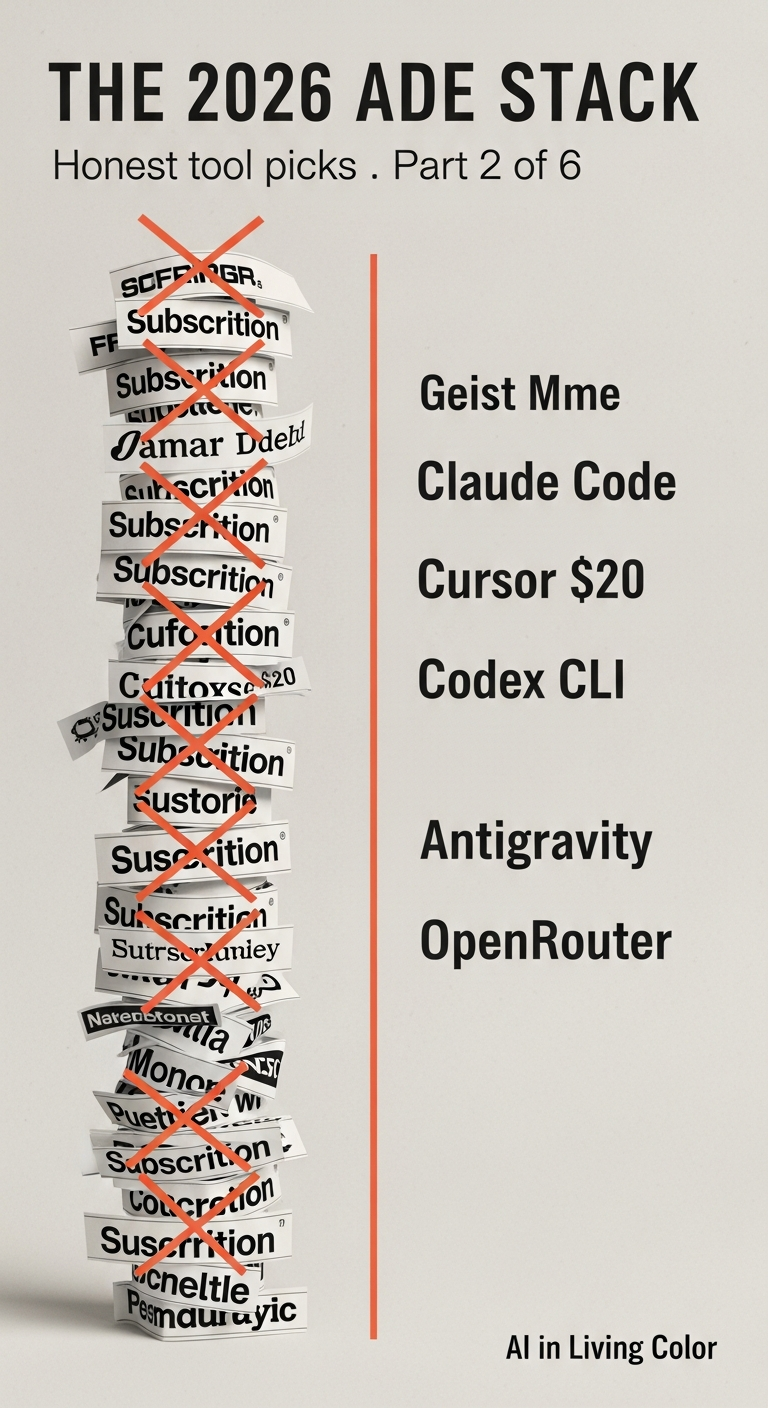
The Principal Engineer's Agentic Coding Bible · Episode 02
The Principal Engineer's Bible, Part 2: The 2026 ADE Stack with Honest Tool Picks
A six-part guide for the IT/Cyber/Cloud generalist now orchestrating AI agents. Part 2: my actual May 2026 stack, the minimum-viable stack if you're starting fresh, and the tools I downgraded or cut. Plus the platform rules and the promotion ladder from Lovable/Replit to Vercel to GCP.
Listen in my voice · AI narration (ElevenLabs clone)
Watch the episode · AI-generated video
On this page
- What actually changed since March
- The four categories (carried from Part 1)
- My actual May 2026 stack
- What I cut in the last 90 days
- The minimum-viable stack if you’re starting fresh in May 2026
- What to skip even though it’s trending
- Platform rules (the non-tool picks that still matter)
- Languages (set once, rarely change)
- Data layer
- Hosting maturity ladder
- Why I’m picking against the “more tools is better” instinct
- What’s next
This is Part 2 of The Principal Engineer’s Agentic Coding Bible. Part 1 (When the IDE Stopped Being an IDE) was the worldview shift. Part 2 is the toolchain reality in May 2026, with honest picks and honest cuts.
The original v3 doc was drafted in March 2026 and is already partially out of date on this chapter. The world moved fast. Antigravity launched at Google I/O. Gemini CLI is sunsetting June 18, 2026. Hermes Agent went from 8.8k stars to 163k stars in three months. Cursor shipped an SDK. xAI launched Grok Build at $300 a month. So this part is half “what’s the current stack” and half “what to ignore from the older guides still circulating.”
What actually changed since March
If you’ve been heads-down on a product and you missed the spring shifts, here’s the diff:
| Thing | March 2026 | Late May 2026 |
|---|---|---|
| Google’s terminal coding agent | Gemini CLI | Antigravity CLI (Go rewrite, async subagents, MCP-native). Gemini CLI sunsets June 18, 2026 for AI Pro/Ultra users. |
| Google’s flagship coding model | Gemini 3.1 Pro | Gemini 3.5 Flash (default in Antigravity, beats 3.1 Pro on agentic benchmarks) and Gemini Omni (multimodal “world model”) |
| Google’s personal agent | Did not exist | Gemini Spark ($100/mo on AI Ultra, 24/7 on a dedicated Google Cloud VM, plugged into Gmail/Docs/Sheets + 30+ services via MCP) |
| Nous Research Hermes Agent | 8.8k stars, “promising” | 163k stars, fastest-growing framework of 2026. Now processes more daily tokens on OpenRouter than OpenClaw (224B/day to OpenClaw’s 186B) |
| xAI in the coding tool fight | Did not exist | Grok Build launched May 14. Agentic CLI competitor to Claude Code. Needs SuperGrok Heavy ($300/mo, or $99/mo intro for 6 months) |
| Cursor as a runtime | IDE + Cloud Agents | @cursor/sdk 1.0.13 (public beta April 29). Programmatic agent runtime in TypeScript. Same billing pool as the IDE. |
| Vercel for AI workloads | AI SDK only | Vercel Workflow SDK GA April 2026 (workflow-sdk.dev). Durable, resumable agent workflows. |
| OpenAI orchestration story | Agents SDK | Plus Symphony (Elixir-based, engineering-preview, Linear → agent → PR pattern) |
If you’re reading anything dated March 2026 or earlier that talks about coding tools, mentally pin those updates in.
The four categories (carried from Part 1)
Part 1 set the framework. Most of what gets loosely called “AI coding tools” falls into four buckets. Knowing which is which keeps you from making bad apples-to-oranges comparisons.
| Category | Definition | 2026 examples |
|---|---|---|
| Agentic IDE | Code editor with AI assistance. You steer each step. Editor is still the surface. | Cursor 1.0, Windsurf (Cascade), Zed (with Claude Code) |
| Agentic Development Environment (ADE) | Desktop UX where chatting with agents is the surface. Goal-level delegation. | Cursor 2.0, Conductor, Google Antigravity |
| Terminal / CLI agent | Headless or terminal-native runtime. Scriptable. Agent IS the surface. | Claude Code, OpenAI Codex CLI, Antigravity CLI, OpenCode, Cline, Grok Build |
| Spec-driven environment | Builds from structured specs first. Reproducible, testable from the start. | AWS Kiro |
Now let’s talk picks.
My actual May 2026 stack
This is the stack open on my machine right now. Not a recommendation list. Just what I run.
| Tool | Category | What it does for me | Spend |
|---|---|---|---|
| Claude Code (terminal + desktop + web + phone) | CLI agent | Default. Everything from quick scripts to multi-day product builds. Remote-control synced across devices so I can steer it from my phone when I’m out. | Pay-per-use, Claude Max plan |
| Cursor at the $20/month plan | Agentic IDE | Light editor + autocomplete + reading codebases. Downgraded from the $200 plan back in Q4 2025 when Codex desktop dropped. Have not regretted it once. | $20/mo |
| OpenAI Codex CLI + Codex desktop app | CLI agent / ADE | Plan-mode work. Codex CLI with the current GPT model is still the best plan writer I’ve found. Worktrees + remote control means I can run multiple agents in parallel without them stepping on each other. | Usage-based, modest |
| Google Antigravity CLI (when it lands fully on AI Pro) | CLI agent | Async subagents, multi-model (Gemini 3.5 Flash default, Claude/GPT-OSS swappable), Skills + Hooks + MCP. Replaces the old Gemini CLI by June 18. Free on AI Pro. | $20/mo (Google AI Pro, already paying for it) |
| OpenRouter | Model router | When I want to swap models for a specific job and don’t want to pay each provider individually. Mostly use it as a fallback. | Pay-per-use |
MCP servers in ~/.cursor/mcp.json | Tool layer | Vercel, Supabase, Linear, GitHub, ElevenLabs, PostHog, Greptile. Every coding agent I run picks these up. Build once, use everywhere. | Free (tool surface) |
That’s the daily kit. Nothing exotic. The big realization is that I do not need an expensive IDE tier on top of two excellent CLI agents and a desktop app that sync everywhere. Most of the value is in the agents, not the editor wrapper around the agents.
What I cut in the last 90 days
The cuts are the real story. Here’s what got dropped and why.
| Cut | Why |
|---|---|
| Cursor $200/month plan (cut Q4 2025) | Codex desktop app shipped, gave me what I was paying the Cursor premium for. Downgraded to $20 the same day. |
| Stacking 5 IDE extensions (Cline, Roo Code, Kilo Code, etc.) (cut late 2025) | Two strong CLI agents (Claude Code + Codex CLI) replaced the entire extension stack. The extensions were rate-limited proxies for what the CLI agents do natively. |
| Paying for individual model APIs I rarely used (cut early 2026) | OpenRouter handles the occasional cross-model job. Fewer credit cards on file, fewer recurring charges to track. |
| Heavy reliance on agentic IDEs in general (cut early 2026) | The shift to ADEs + CLI agents made the editor-centric workflow feel slower for almost everything except quick edits. |
| Cline as my main extension (cut mid-2025) | Cycled through Cline → Roo Code → Kilo Code with OpenRouter switching for a while. Stopped when extensions became less interesting than the agents underneath. |
The unifying theme: pay for capability, not for surface. Every time I caught myself paying for a wrapper around something I already had access to, I cut it.
The minimum-viable stack if you’re starting fresh in May 2026
You’re a 12-year IT/Cyber/Cloud generalist, $0 in sunk cost, $0 in active subscriptions. This week you want to be operating like a principal engineer. Here’s the stack I’d put you on:
| Tool | Why | Spend |
|---|---|---|
| Claude Code (start with the $20/mo Claude Pro, upgrade to Max later) | Strongest CLI agent in 2026. Sub/usage hybrid pricing means you can start cheap and scale. Works across terminal, desktop, web, and phone with remote control. | $20/mo to start |
| Cursor $20/mo plan (NOT the $200 tier) | Light editor + reading + occasional autocomplete. You’ll lean on Claude Code for the heavy work but keep Cursor as the comfortable text editor. | $20/mo |
| Google AI Pro for Antigravity CLI | Antigravity is genuinely good and you’ve probably already got the Google subscription for Workspace/Drive anyway. Free addition to your toolchain. | $20/mo (you likely already pay for Workspace) |
| OpenRouter | One account, all models. You will need cross-model work eventually. | Pay-per-use, $5 to start |
| Free fallbacks installed but not active: OpenCode, Cline | Insurance. If you ever want to test 75+ models or want privacy-first work, they’re there. | $0 |
| MCP server discipline from day 1 | Wire ~/.cursor/mcp.json for the services you actually use (Vercel, Supabase, GitHub, the platform you’re building on). Every agent inherits them. | $0 |
Total starting spend: ~$60/month plus modest API usage. That gets you a stack that beats almost every $300/month enterprise tier on the actual jobs you’ll do as an operator.
What to skip even though it’s trending
Listen, hot takes section. If you push back on any of these, push back loud and I’ll publish the rebuttal.
- Skip SuperGrok Heavy at $300/mo just to get Grok Build. Grok Build is impressive, but at $300/mo it has to be uniquely worth that. For most generalists, Claude Code + Codex CLI cover the same surface for a fifth of the cost.
- Skip the $200/month Cursor plan unless you specifically need it for a multi-engineer team workflow. Solo? You’re paying for capacity you’ll never use.
- Skip stacking 4 IDE extensions on top of each other. You’re going to spend more time managing the extensions than the code. Pick a strong CLI agent or two and run them in worktrees.
- Skip paid individual subscriptions to every model provider. Use OpenRouter for the rotation.
- Skip “the trendy new framework” until it has crossed 25k stars OR shipped a v1.0. 2026 is a generative bubble for AI dev tools. Most won’t survive the year. Wait for traction.
- Skip Hermes Agent unless you specifically need persistent self-improving memory. It is genuinely strong (163k stars in 3 months tells you something), but if you’re not running long-horizon autonomous projects, you don’t need it yet.
- Skip OpenAI Symphony for now. Elixir-based, engineering preview, oriented at Linear-style task queues. Cool, but not a fit unless your team already operates on tickets and you’re trying to automate the ticket → PR loop.
Platform rules (the non-tool picks that still matter)
The original v3 doc had Chapter 4 as “Platform Rules and Technology Choices.” Most of that aged well. Here it is, updated.
Languages (set once, rarely change)
| Domain | Default | When to deviate |
|---|---|---|
| Web frontend | TypeScript | Never. |
| API backend | TypeScript | Python for ML, Go for high-throughput. |
| Agent runtime | TypeScript | Python if you need heavy ML library integration. |
| Data / ETL / Automation | Python | TypeScript if you’re already living in the TS ecosystem (Vercel AI SDK + Workflow SDK now make this very reasonable). |
| High-throughput workers | Go | TypeScript if your team can’t maintain Go. |
The 2026 update to this table is that the gap between “you should use Python for X” and “you can do X in TypeScript” closed a lot. The Vercel AI SDK + Workflow SDK story makes TS-everywhere a more defensible posture than it was a year ago.
Data layer
Default: Postgres everywhere, via Supabase, unless you have a reason.
| Scenario | Choice |
|---|---|
| MVP / V1 | Supabase Postgres. Free tier is generous. Row-level security gets you tenant isolation for free. |
| Realtime features | Supabase Realtime first. |
| Complex realtime-first product | Consider Convex. The 2026 reason is the first-party @convex-dev/agent component, which handles thread persistence + hybrid vector/text search + auto-injected context for LLM calls. If you’re building an AI-heavy app, Convex’s reactive-by-default queries plus the Agent component save you a real chunk of plumbing. |
| Enterprise / compliance | Managed Postgres (Cloud SQL, RDS). |
| Analytics / OLAP | Add DuckDB or ClickHouse alongside the OLTP store. |
Hosting maturity ladder
Frontend: always Vercel. Preview deploys on every PR, staging for QA, production with auto-scaling. Worth every cent.
Backend ladder, in promotion order:
| Stage | Backend location | Trigger to promote |
|---|---|---|
| MVP | Lovable / Replit | Working prototype with paying users on it |
| V1 | Stay where you are if it’s stable | Hit $10k MRR OR reliability issues you can’t fix in place |
| Mature | GCP Cloud Run | Performance, compliance, cost optimization at scale |
There’s a tendency to want to go straight to GCP from day one. Don’t. The promotion ladder is the ladder for a reason. Premature infrastructure is the original sin of indie founders. Lovable to Vercel to GCP is the path that lets you focus on the product until the product earns the right to expensive infrastructure.
Why I’m picking against the “more tools is better” instinct
The biggest mistake I made in my own stack journey through 2025 was stacking. More extensions. More providers. More frameworks. Every new release was something I wanted to add.
In late 2025 when Opus 4.5 dropped and the mental model shifted to ADE, I had to do an honest audit. Most of the tools I was paying for were redundant with each other. The good CLI agents replaced four extensions. The desktop apps replaced expensive IDE tiers. OpenRouter replaced six individual API subscriptions.
Lean is not the same as cheap. Lean means every tool in the kit has a job that no other tool in the kit can do. If two tools are doing 80% of the same job, one of them isn’t earning its place.
That’s the lens I’d encourage you to bring to your own stack audit this week. Open a doc, list every AI dev tool you’re paying for or stacking, and write next to each one the one job it does that nothing else in the kit can do. If you can’t write the sentence, that’s the tool to cut.
What’s next
Part 3 is the security spine. This is where my SOC brain takes over. We never fixed SSDLC. Now AI-DLC is showing up alongside it, with new attack surfaces specific to agents: MCP server poisoning, prompt injection from scraped content, hallucinated dependencies in supply chain, non-human identity sprawl. The puzzle pieces are mostly solved. They’re just scattered across the playing board and nobody’s connected them yet. We’re going to.
Part 4 will be the agentic engineering army (roles, orchestration frameworks, repo standards, CI/CD gates). Part 5 is production architecture from MVP to real apps. Part 6 is the operating system you actually run day-to-day.
Subscribe to AI in Living Color below if you want each part dropped into your inbox as it ships. No spam. Just the thing you came for.
This is Part 2 of “The Principal Engineer’s Agentic Coding Bible,” v3.0, originally drafted March 2026, now publishing in pieces through 2026 in my actual voice. Built in public.
Sources and recommended reading: Anthropic, Introducing Claude Opus 4.5 (2025-11-24) · Google, Antigravity CLI transition · xAI, Introducing Grok Build · Cursor, TypeScript SDK release · Vercel, Workflow SDK GA · Convex AI Agent component · Hermes Agent vs OpenClaw