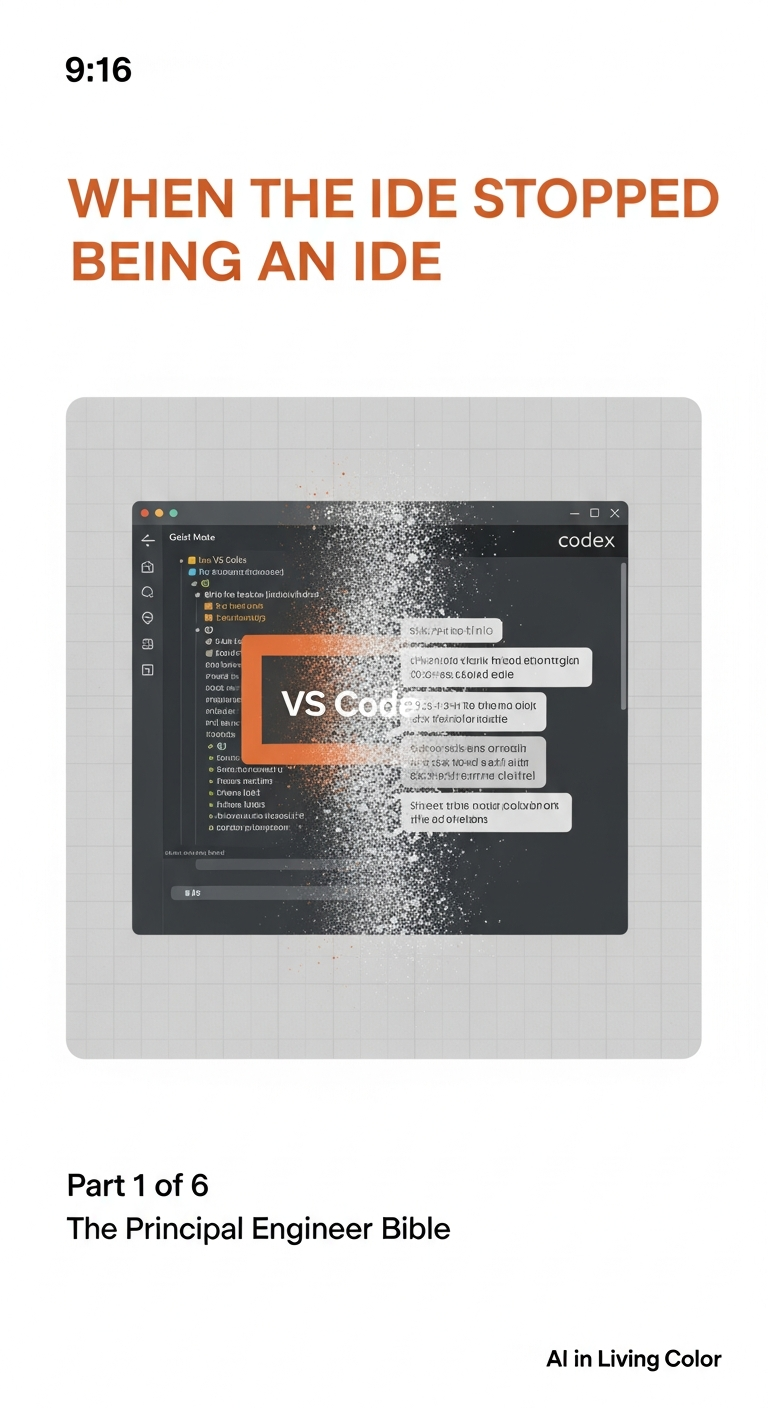
The Principal Engineer's Agentic Coding Bible · Episode 01
The Principal Engineer's Bible, Part 1: When the IDE Stopped Being an IDE
A six-part guide for the IT/Cyber/Cloud generalist now orchestrating AI agents instead of writing code. Part 1: the moment the mental model broke, why the tool stopped being an IDE, and the discipline that survives. Spec-Driven, Context, and Harness engineering across the new Agentic Development Life Cycle.
Listen in my voice · AI narration (ElevenLabs clone)
Watch the episode · AI-generated video
On this page
- The moment the mental model broke
- The 2026 ADE landscape (it’s not as flat as the hype says)
- The North Star (this is the inversion)
- The Agentic Development Life Cycle (this is the better framing than goals/metrics)
- The Three Pillars of Agentic Engineering
- Pillar 1: Spec-Driven Development
- Pillar 2: Context Engineering
- Pillar 3: Harness Engineering
- Why this matters for an IT/Cyber/Cloud generalist
- What’s next in this series
This is Part 1 of a six-part series. The full thing started life as a doc I wrote in March 2026 called The Principal Engineer’s Agentic Coding Bible v3. The world moved on me between drafting and shipping. Antigravity launched. Gemini Spark dropped. Hermes Agent went from 8.8k stars to 163k. And one word started showing up everywhere on my timeline: ADE.
So I’m publishing it in pieces, refreshed to where we actually are in May 2026, in my actual voice. Part 1 is the worldview shift. Why the tool you’ve been calling an IDE stopped being one, and what the new discipline looks like.
The moment the mental model broke
I can tell you exactly when this happened for me. Late 2025. Specifically that September to December stretch. And I think a lot of people felt this. It wasn’t just me sitting in my office finally noticing.
It was when Opus 4.5 dropped on November 24, 2025. The first model to break 80 percent on SWE-bench Verified (80.9 percent, to be exact), and Anthropic dropped the price by something like 67 percent in the same breath. What changed wasn’t that Opus could write better code in isolation. What changed was that it was quite literally like: oh, I can just really prompt, give context, and this agent is really gonna do its thing.
I noticed it inside the VS Code plug-in first. By that point I had already burned through a tour of every extension on the market. I had shifted from Cline to Roo Code to Kilo Code, and I was big on OpenRouter with model switching between them. The extension was the workbench. The model was the swappable brain. That felt cutting-edge for about four months.
Then my main extension became Claude Code + Codex CLI inside Cursor. At the time, Codex CLI with GPT-5 was good. Like really good. A really, really good plan writer. So my pattern was, write the plan with the Codex plug-in inside Cursor, then go into build mode with the Claude Code extension in Cursor. And I was sitting there going, man, this is pretty damn good.
Then the Codex desktop app dropped.
That was the moment.
I was on the Cursor $200/month plan. The day Codex desktop landed, I immediately went down to the $20/month plan. Because I’m sitting there going: this is all I need. I can literally use the OpenAI Codex macOS desktop app with worktrees and remote control and I’m good to go.
And then the Claude desktop app added Claude Code inside it. Then the web Claude Code. Then everything on your phone, synced across devices.
And I’m like, there’s really no need for IDE.
Then I started seeing the word ADE going around on X. I Googled it of course. Sure enough. Agentic Development Environment. Somebody finally named the thing.
So look at the arc:
Autocomplete. Then multiple extensions stacked on top of an IDE. Then two extensions (Claude Code + Codex). Then each of those extensions getting its own desktop app. Then the IDE underneath them gone entirely. Now we call it an ADE.
The IDE didn’t get killed in a press release. It got quietly hollowed out tool by tool until what we were calling an IDE wasn’t doing the IDE job anymore. The job changed shape. The name lagged the job by about a year. That’s all that happened.
The 2026 ADE landscape (it’s not as flat as the hype says)
Here is where the labeling actually matters. Most of what people loosely call “AI coding tools” in 2026 fall into four buckets, and you’d be a smarter operator knowing which is which:
| Category | What it actually is | 2026 examples |
|---|---|---|
| Agentic IDE | Code editor with AI assistance bolted on. You steer each step. You still look at the code most of the time. | Cursor 1.0, Windsurf (with Cascade), Zed (with Claude Code integration) |
| Agentic Development Environment (ADE) | Desktop UX where the focus is chatting with agents, not looking at code. Agent-first architecture, goal-level delegation. | Cursor 2.0, Conductor, Google Antigravity |
| Terminal / CLI agent | Headless or terminal-native agent runtimes you can script. The agent IS the surface, no editor in the loop. | Claude Code, OpenAI Codex CLI, OpenCode, Cline, Grok Build |
| Spec-driven environment | Builds from structured specs and hooks before generating code. Reproducible, testable, documented from the start. | AWS Kiro |
The 2026 ADE shortlist (real ADEs, not “agentic IDEs that rebranded”): for most of 2026 there were really only Cursor 2.0 and Conductor. Google Antigravity landed at I/O 2026 and made it three. The Augment Code crowd argues for adding Coder, Warp, and Intent depending on how you slice enterprise versus indie use cases, and that’s fair. JetBrains turned Fleet into Air for the same reason: their editor-shaped product needed to be agent-first to survive.
You don’t need to use the same ADE forever. The point of getting the labels right is so you can talk honestly about what kind of tool you’re picking up. An agentic IDE and an ADE are not interchangeable. They are different shapes of work.
The North Star (this is the inversion)
Here’s the part of this series I want to be careful with, because the conventional wisdom is wrong.
The North Star is not “you’ll never be a Theo or a Primeagen-level implementer, so stop trying.” The North Star is the exact opposite.
The North Star is that we can all now output at the level of a staff, principal, or founding engineer. Theo and Primeagen levels of code shipping are not gatekept anymore. They are inside reach for any operator who does two things at the same time:
- Hone the tools to the absolute max. Treat the ADE, the CLI agent, the spec workflow, and the harness like instruments you practice on, not toys.
- Keep learning the foundations. This part cannot be skipped, and the people who try to skip it are exactly who you watch hit a wall in month three.
If you only have tools without foundations, you are a vibe coder. You can demo. You cannot ship.
If you only have foundations without tools, you are an unleveraged senior engineer in 2026. You will get out-shipped by people with half your experience who learned the tools.
The compound of both is what makes a 12-year IT/Cyber/Cloud veteran absolutely lethal in this era. You already have the foundations. You spent a decade earning them in incident response, in production firefights, in audit prep, in cloud bill reviews, in threat modeling sessions. Nobody can hand you those by buying a Cursor sub. And the tools, you can learn faster than someone trying to learn the foundations the hard way.
The combination is the moat.
The Agentic Development Life Cycle (this is the better framing than goals/metrics)
The original v3 doc framed all this as a goals-and-metrics table: ship MVPs fast, prevent hallucinations, prevent security mistakes, etc. The metrics themselves are right, but the framing missed where the industry actually went.
The cleaner way to think about this is to look at the discipline progression. We went from SDLC, to SSDLC, to what is now being called AI-DLC (Agentic Development Life Cycle):
| Era | Discipline | What it added on top of the prior era | Triggered by |
|---|---|---|---|
| 1990s through early 2010s | SDLC (Software Development Life Cycle) | Agile, Kanban, daily standups, ticket flow, sprint cadence | Agile manifesto, OOP maturity, web stacks stabilizing |
| Mid-2010s onward (post-2015) | SSDLC (Secure SDLC) | Security shifted left into the dev workflow. Product security teams stood up. SAST, DAST, CSPM (Wiz, Orca, et al.) embedded into CI/CD, repos, and yes, IDEs. | Cloud-first / SaaS explosion. The 2010 to 2015 mobile-then-cloud push made security an everywhere problem. |
| 2025 onward | AI-DLC (Agentic Development Life Cycle) | Agents become participants in every phase. Harness engineering becomes a real discipline. Runtime governance, model provenance, MCP server integrity, and NHI (non-human identity) controls for agents themselves. | Frontier model capability shift (Opus 4.5, Gemini 3.x, GPT-5). ADE emergence. |
The metrics from the original doc (ship MVPs in under 7 days, zero broken imports in prod, zero exposed secrets, one design system per product, professional ops practices) are not the framework. They are the outputs of the framework. AI-DLC is the framework, and it inherits from SDLC and SSDLC, it does not replace them.
The clearest articulation of how AI-DLC actually looks at the workflow level (and not just at the org-chart level) is Matt Pocock’s 7 Phases of AI Development. Pocock specifically frames this for “engineers serious about building lasting applications, not vibe coders.” Sound familiar.
| Phase | Name | What it actually is | Why it matters for agentic work |
|---|---|---|---|
| 1 | The Idea | Define the project scope: app, feature, or refactor | The agent needs a target to point at |
| 2 | Research (optional) | Cache external dependencies and difficult exploration in a research.md | Prevents agent drift, prevents hallucinated libraries |
| 3 | Prototyping (optional) | Explore multiple design approaches before committing | Concrete examples beat abstract instructions for agents |
| 4 | Product Requirements Document | Document the end state and user-facing behavior | This is where the spec from Pillar 1 lives |
| 5 | Implementation Planning | Kanban board with dependency-aware tickets | Enables parallel agent execution |
| 6 | Execution | Run coding agents to implement tickets (“Ralph loops”) | This is where agents actually do the work |
| 7 | Quality Assurance | QA plan, additional execution cycles | The harness gate, basically |
Pocock’s framework lines up with the Three Pillars I’ll cover next. Spec-Driven Development lives in Phases 1, 4, and 5. Context Engineering lives in Phases 2 and 3. Harness Engineering wraps Phases 6 and 7. If you read the Pocock piece (linked at the bottom), you’re reading the same playbook in slightly different language. The fact that multiple people arrived at the same shape independently in 2026 is the signal that this is the actual move.
The Three Pillars of Agentic Engineering
The reason agentic engineering works as a discipline, and not just as Twitter cope, is that 2026 crystallized three connected practices that separate professional operators from vibe coders. Master all three.
Pillar 1: Spec-Driven Development
Spec-Driven Development (SDD) flips the old loop. The old loop was:
Requirements → Design → Manual Coding → Testing
The new loop is:
Requirements → Detailed Specification → AI Generation → Validation
The spec is the source of truth. The code is the generated artifact. Once you accept that, a lot of arguments about prompts go away.
“The real unlock wasn’t better prompts. It was structured specifications that any agent could execute deterministically.” ThoughtWorks Technology Radar, 2026
Three levels of spec rigor, in increasing seriousness:
| Level | What it is | Best for |
|---|---|---|
| Spec-First | Write the full spec before any code. Agent generates from spec. | Greenfield projects, critical features. |
| Spec-Anchored | Maintain a living spec that evolves alongside the code. Agent references spec for context. | Iterative work where the destination shifts as you go. |
| Spec-as-Source | The spec is the source code. Executable specs that compile to implementations. | Emerging in 2026, still rough at the edges. This is where it’s going. |
In practice:
- Use GitHub Spec Kit (72.7k stars, supports 22+ agent platforms) as the standard tooling.
- Every feature starts with a structured spec: problem statement, acceptance criteria, data contracts, error handling.
- Agents execute against specs, not against freeform prompts.
- Specs are versioned, reviewed, and treated as first-class code artifacts.
- Clear specifications reduce hallucinations because they give the agent a semi-structured input to anchor on.
You’ll be tempted to skip this when you’re moving fast. Don’t. The 30 minutes you spend writing a real spec saves you four hours of debugging hallucinated endpoints later. I have learned this the painful way.
Pillar 2: Context Engineering
Context engineering has replaced prompt engineering as the core craft. Prompt engineering is asking nicely. Context engineering is designing what information the agent sees, when it sees it, and how it’s structured. It’s not vibes. It’s information architecture for agents.
The five core strategies:
| Strategy | What it means in practice |
|---|---|
| Selection | Choose what goes into context. Codebase files, docs, specs, error logs. Not everything belongs. Most things don’t. |
| Compression | Summarize and distill. Use tree-sitter outlines instead of full files. Provide API signatures instead of implementations. |
| Ordering | Most relevant context goes closest to the instruction. Recency and relevance both matter. The model reads in order. |
| Isolation | Multi-agent setups need separate contexts. Don’t pollute one agent’s context with another’s state. |
| Format optimization | Structure context in formats the model processes best. XML tags, Markdown headers, typed schemas. Format matters. |
In practice:
- Build your
CLAUDE.md,agents.md, or rules files iteratively. Start minimal. Add as you discover gaps. - Don’t over-stuff context. Modern frontier models are powerful and often need less than you think.
- Use scratchpad files for agent working memory within a session.
- For teams shipping AI-heavy products: appoint a context engineering lead. It’s a real role now.
Pillar 3: Harness Engineering
Here’s the one most teams are sleeping on, and it’s the one that separates “we use AI” from “we ship with AI.”
Harness engineering is designing the constraints, tools, feedback loops, and verification systems that wrap around AI agents to make them reliable in production. In 2026 the hard lesson is: the agent isn’t the hard part. The harness is.
“In early 2026, OpenAI built an internal product with over 1 million lines of code, zero lines manually written, using Codex agents under a strict ‘no manual code’ constraint. This forced the creation of a robust harness that increased engineering velocity by orders of magnitude.” OpenAI Engineering Blog
What a real harness includes:
| Component | What it does |
|---|---|
| Tool definitions and allowlists | Constrain what agents can do. No unbounded shell. No production writes by default. |
| Verification gates | Lint, typecheck, test, build, all running after every agent action. |
| Feedback loops | Route failures back to the agent for self-correction. |
| Observability | Monitor agent behavior in production. You can’t fix what you can’t see. |
| Safety guardrails | No production writes, no arbitrary shell, no secret exposure. |
| Rollback mechanisms | For when agent output causes regressions. Because it will. |
The shift this names is the one that matters most. The primary battleground of software engineering is migrating away from writing code. The new frontier is designing the environments, constraints, and governance mechanisms that control autonomous agents. The competitive advantage belongs to whoever has the most effective harness, not whoever has the largest model.
You can run Opus 4.5, Gemini 3.5 Flash, and Grok 4.3 inside a great harness and ship faster than someone running the same models inside a bad one. The harness compounds.
Why this matters for an IT/Cyber/Cloud generalist
Bringing it back to the North Star. The Three Pillars are exactly what a 12-year IT/cyber/cloud veteran is wired to do well. You’ve been writing specs your whole career. They were called change requests, runbooks, ADRs, incident postmortems. You’ve been doing context engineering since the first time you wrote a tight Jira ticket. You’ve been doing harness engineering since the first time you stood up a CI/CD pipeline with quality gates and rollback procedures.
The agentic shift isn’t asking you to become a 10x implementer. It’s asking you to apply the operations brain you already have to a new substrate. The thing you’ve been doing for a decade, making systems behave under constraints, is exactly the thing that’s now valuable at the top of the stack.
That’s why the answer to “can I really code at staff/principal/founding level now?” is yes. With the tools at max and the foundations kept current, the ceiling moved up to where you were already standing.
Vibe coding gets you to a demo. Spec-Driven plus Context plus Harness, deployed inside a proper AI-DLC, gets you to production.
What’s next in this series
If the IDE stopped being an IDE, the rest of the toolchain stopped being what we thought it was too. Part 2 is the 2026 ADE stack with honest picks. Who’s actually good in May 2026, who’s overhyped, what each tier is good for, and what I run on my own machine.
Part 3 is the security spine, and this is where my SOC brain takes over. Because we never fixed SSDLC. Now AI-DLC is showing up alongside it. The pieces are solved. They’re just scattered across the playing board, and a mandate is coming. We’re going to put the puzzle back together.
Parts 4 through 6: standing up the agentic engineering army, production architecture from MVP to real apps, and the operating system you actually run day-to-day.
Subscribe below if you want each part dropped into your inbox as it ships. No spam. Just the thing you came for.
This is Part 1 of “The Principal Engineer’s Agentic Coding Bible,” v3.0, originally drafted March 2026, now publishing in pieces through 2026 in my actual voice. The doc was a guide. The series is a record of how I’m operating. Built in public.
Sources and recommended reading: Anthropic, Introducing Claude Opus 4.5 (2025-11-24) · Matt Pocock, My 7 Phases of AI Development · The ADE Wars (Medium) · Augment Code, Agentic IDE vs ADE · GitHub Spec Kit