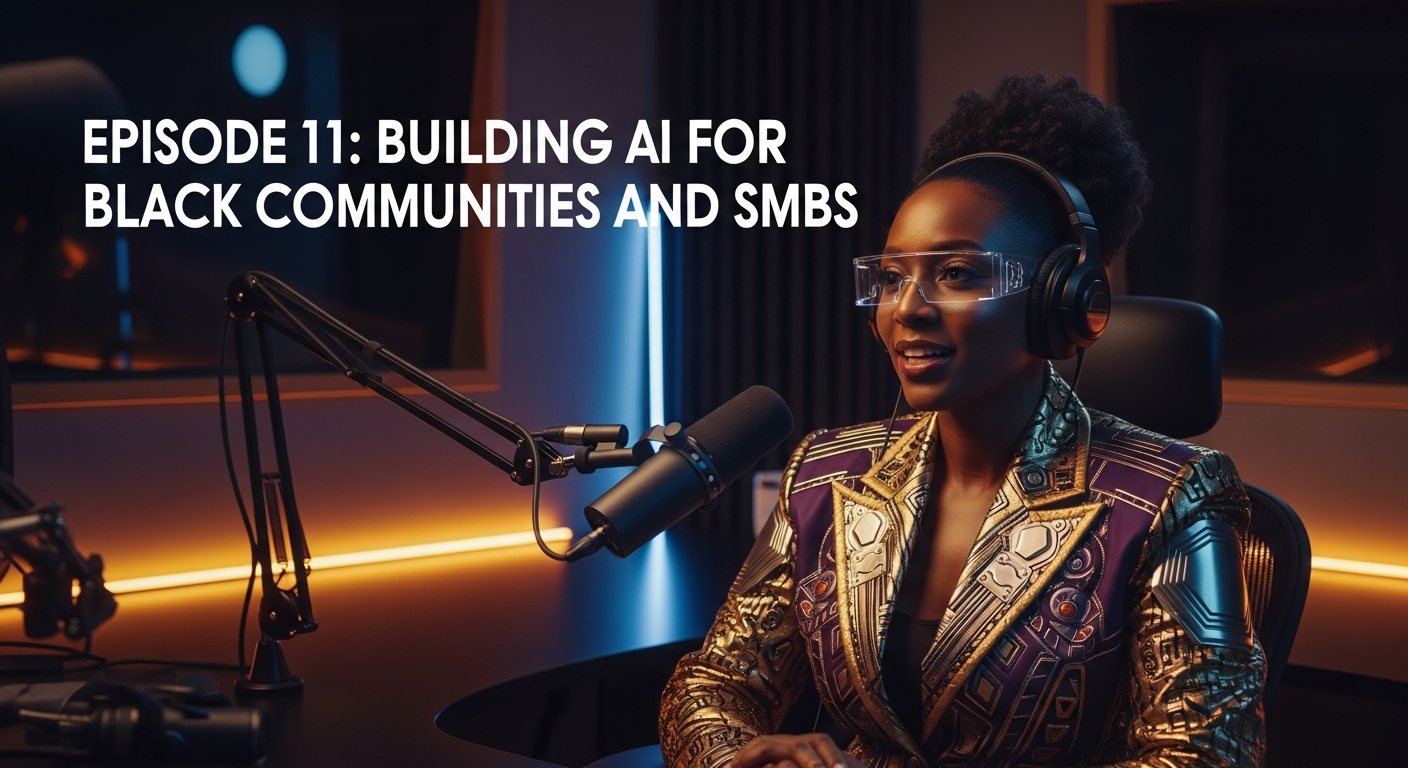
Voice AI Engineering · Episode 11
Building AI for Black Communities and SMBs
Black communities shouldn't only be consumers of AI—they should be builders, owners, and beneficiaries: the case for starting with real community friction, not the latest model, and why data stewardship is a non-negotiable design constraint.
Listen in my voice · AI narration (ElevenLabs clone)
Watch the episode · AI-generated video
On this page
Hey guys, I’m Chris Watkins, also known as Bingo Codes. I’m a security engineer transitioning into voice-first AI engineering while building Djembe AI and Big Mama, a culturally grounded voice-first agentic AI platform designed to help Black communities discover businesses, preserve culture, and help small and mid-sized businesses (SMBs) grow through intelligent AI systems.
If AI is going to reshape how people discover information, make decisions, and run businesses, then Black communities should not only be consumers of that technology. We should be builders, owners, and beneficiaries. This article is about why I’m building Djembe AI, what Big Mama should do for the community, and how I’m thinking about culture, business, and responsibility.
Start With the Problem, Not the Model
When we talk about building AI, it is easy to get caught up in the hype cycle of the latest large language models (LLMs) or the newest framework. But as a security engineer, I know that technology is only as good as the problems it solves and the trust it earns. The product should begin with real community and business needs. Black-owned businesses need discovery, customer trust, operational support, and visibility. Communities need access to cultural events, local services, historical knowledge, and trusted recommendations.
The question is not, “How do I force AI into the community?” The question is, “Where are people already carrying friction, and can AI reduce it without extracting from them?” This framing keeps Djembe AI grounded. It ensures that we are building systems that are useful, reliable, observable, secure, and accountable. We are not building AI for the sake of AI; we are building infrastructure that addresses tangible pain points.
When I look at the landscape of AI tools today, many are built with a generic user in mind. But communities are not generic. They have specific contexts, histories, and needs. By starting with the problem, we ensure that Big Mama is designed to navigate these nuances. We are looking at the friction points in how people find a good barber, how a local bakery manages its weekend rush, or how a community center promotes its events. These are the real-world scenarios where AI can make a difference, provided it is built with intention and care.
Discovery as Economic Infrastructure
Discovery is not trivial. If people cannot find a business, the business loses opportunity. If people cannot find events, resources, and cultural spaces, community connection gets weaker. Traditional search engines and directories often fall short when it comes to hyper-local, culturally specific discovery. They rely on algorithms that prioritize paid placements or generic popularity metrics, which can marginalize smaller, community-focused businesses.
Big Mama can help by making discovery conversational. Instead of navigating menus or forms, a user could ask for a Black-owned restaurant near them, a barber with weekend appointments, a family-friendly cultural event, or a local service provider.
| User Need | Big Mama Response Goal |
|---|---|
| Find Black-owned businesses | Return relevant, current, and trustworthy options. |
| Discover cultural events | Match by location, date, family needs, and interest. |
| Support local spending | Help users choose businesses aligned with their needs. |
| Help SMBs explain themselves | Turn business details into clear profiles, FAQs, and posts. |
This is where the agentic nature of Big Mama shines. It is not just a chatbot; it is a system that listens, understands context, takes action through tools, remembers useful information with permission, and helps users accomplish real-world tasks. When a user asks for a recommendation, Big Mama isn’t just pulling from a static list; it is reasoning about the user’s intent, location, and preferences to provide a tailored response. This transforms discovery from a passive search experience into an active, supportive conversation.
Furthermore, this conversational approach lowers the barrier to entry for users who might not be comfortable with complex search queries or navigating multiple apps. Voice-first interaction means users can speak naturally, making the technology accessible to a broader demographic, including older generations who are vital keepers of community knowledge.
Preservation and Cultural Knowledge
Cultural preservation means more than storing facts. It means respecting stories, context, language, lineage, and ownership. Big Mama should not scrape culture and package it without accountability.
If Djembe AI touches culture, then data stewardship matters. Who contributed the knowledge? Who benefits? Who can correct it? Who controls it? This is a critical security and trust boundary. We cannot treat cultural data as just another dataset to be ingested. This is where the product may need community partnerships, editorial review, source attribution, and correction workflows. As a builder, I have to ensure that the system architecture supports these requirements, from how data is stored to how it is retrieved and presented.
Consider the history of a local neighborhood or the legacy of a long-standing community business. This information is often passed down orally or held in local archives. If an AI system is going to represent this knowledge, it must do so with fidelity and respect. It cannot hallucinate facts or strip away the cultural context that gives the information its meaning.
To achieve this, we have to think about provenance. Where did this data come from? Is it verified by the community? If a user asks Big Mama about the history of a specific cultural festival, the response should be grounded in trusted sources, and those sources should be acknowledged. This approach not only preserves the culture accurately but also builds trust with the users who rely on the system.
SMB Growth Through Practical AI
Many small businesses do not need a complicated AI transformation strategy. They need help with basic but time-consuming work: getting discovered, answering common questions, planning promotions, organizing follow-up, and understanding customer patterns.
Big Mama can support SMB owners by acting as a practical assistant. By integrating with calendars, CRMs, messaging tools, and business workflows, Big Mama can help SMBs operate more efficiently.
| SMB Workflow | AI Support |
|---|---|
| Business profile creation | Help write clear descriptions and service lists. |
| Customer FAQ | Generate answers from verified business information. |
| Promotion planning | Suggest campaigns based on events, seasonality, and goals. |
| Calendar reminders | Help owners follow through on operational tasks. |
| Customer discovery | Help customers find the right business faster. |
Imagine a local caterer who spends hours each week answering the same questions about menu options, pricing, and availability. Big Mama can handle these inquiries conversationally, freeing up the owner to focus on cooking and growing the business. Or consider a boutique clothing store that wants to run a promotion for an upcoming cultural holiday. Big Mama can help draft the promotional copy, suggest the best times to post on social media, and even remind the owner to follow up with interested customers.
This is practical AI. It is not about replacing human creativity or connection; it is about augmenting the capabilities of small business owners who are often stretched thin. By providing these tools, we empower SMBs to compete more effectively and serve their communities better.
Avoiding Extractive AI
AI for communities can become extractive if it takes data, attention, or cultural value without returning ownership, benefit, or control. Culturally grounded AI cannot just mean the interface sounds familiar. It has to mean the value flows back to the people and businesses the system represents.
Djembe AI should prioritize data rights, business control, transparency, and feedback loops. Business owners should be able to claim, update, and correct their profiles. Users should be able to flag bad recommendations. From a security engineering perspective, this means building robust authentication, authorization, and audit trails. It means designing systems that fail safely and recover gracefully.
Extractive AI models often treat user data as a raw material to be mined for profit, with little regard for the communities that generated it. We have to flip that model on its head. If a community contributes data to Big Mama, that community should see a direct benefit, whether through improved discovery for local businesses, better access to cultural resources, or even direct economic incentives.
This requires a fundamental shift in how we think about data ownership and governance. We need to build mechanisms that allow communities to have a say in how their data is used and to ensure that the AI systems operating in their spaces are accountable to them. This is not just an ethical imperative; it is a technical challenge that requires innovative approaches to system design and data architecture.
Trust, Safety, and Representation
Trust is built through accuracy, transparency, correction, and humility. Big Mama should not overclaim. If the system is unsure, it should say so. If a business detail is outdated, it should make verification easy. If a user corrects something, the system should learn through an approved workflow.
Representation is not just who appears in the database. It is who has power over the data and the product decisions. This is why building in public is so important. It invites scrutiny, feedback, and collaboration. It allows the community to see the tradeoffs we are making and to hold us accountable for the outcomes.
As a security engineer, I approach trust and safety not as an afterthought, but as a core component of the system architecture. We have to anticipate failure modes and abuse cases. What happens if someone tries to manipulate the discovery algorithm to harm a competitor? What happens if the system inadvertently amplifies harmful stereotypes? We have to build guardrails and observability into the system from day one to detect and mitigate these risks.
Furthermore, we have to ensure that the teams building these systems are representative of the communities they serve. Diverse perspectives are essential for identifying blind spots and designing solutions that are truly inclusive. By building Djembe AI in public, I hope to encourage more Black engineers, designers, and product managers to enter the field of voice-first AI and contribute their expertise to this critical work.
Product Principles for Djembe AI
To ensure we stay aligned with our mission, we have established a clear set of principles for Djembe AI:
| Principle | Meaning |
|---|---|
| Build with, not just for. | Community feedback should shape product decisions. |
| Preserve dignity. | Avoid stereotypes, shallow cultural cues, or exploitative framing. |
| Make value practical. | Help users and SMBs accomplish concrete tasks. |
| Keep data accountable. | Show sources, ownership, correction paths, and retention policies. |
| Design for trust. | Use permissions, confirmations, and transparent memory. |
| Create proof-of-work. | Let the build show technical seriousness and mission alignment. |
These principles are not just marketing slogans; they are the criteria by which we evaluate every technical and product decision. When we are deciding which features to prioritize, or how to design a specific interaction, we refer back to these principles to ensure we are staying true to our vision.
The Big Mama Build Connection
So, what does this mean for Big Mama? It means we start with focused community-centered workflows. Strong early candidates include local business discovery, event discovery, SMB profile assistance, promotion planning, and calendar reminders.
If Big Mama can help one customer find one business, help one owner show up more clearly, or help one community event reach the right people, that is real value. This is the proof-of-work that matters. It is not about building the most complex AI system in the world; it is about building the most useful and trustworthy system for the communities we serve.
As we continue to develop Big Mama, we will be focusing on integrating these capabilities into a seamless, voice-first experience. We will be testing different approaches to memory and planning to ensure the system can provide personalized assistance without compromising privacy. And we will be working closely with local businesses and community members to refine the product and ensure it meets their needs.
Closing
Next episode is the series finale: how to become a voice AI engineer. I’m going to turn this whole journey into a practical roadmap for anyone who wants to build in real-time agents, voice systems, and production AI.
If you are building in AI, security, voice infrastructure, or community-centered technology, follow along. This series is my public proof-of-work as I learn, build, and ship Djembe AI and Big Mama in public. Drop a comment with what you want me to build or explain next, and I’ll see you in the next episode.
Carousel
The episode in slides
9 slides. Tap any to view full size.