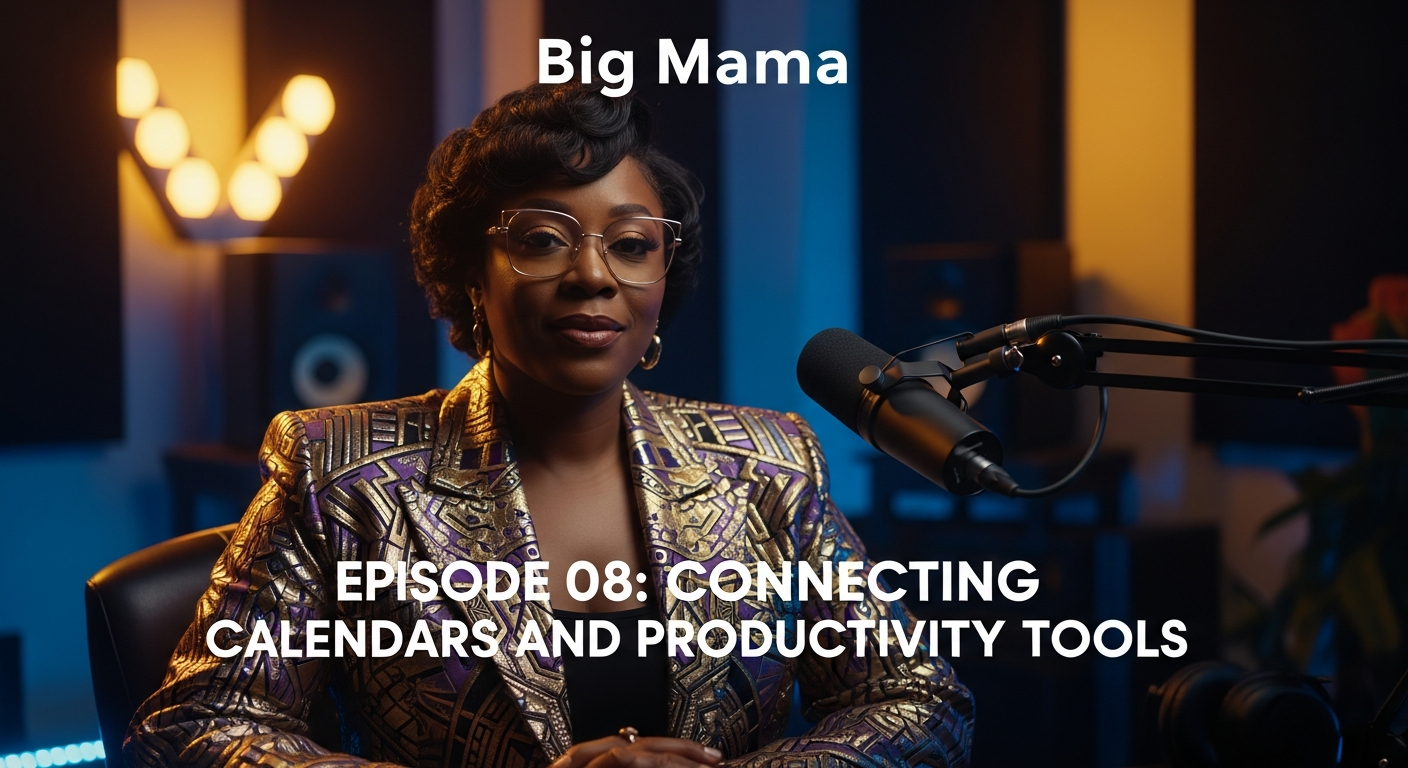
Voice AI Engineering · Episode 08
Connecting Calendars and Productivity Tools: Giving AI Agents Real-World Utility
When an AI agent connects to your calendar and task tools it stops being advice and starts taking action—here's how to design those integrations securely, with least-privilege permissions and per-action confirmation gates.
Listen in my voice · AI narration (ElevenLabs clone)
Watch the episode · AI-generated video
On this page
Hey guys, I’m Chris Watkins, also known as Bingo Codes. I’m a security engineer transitioning into voice-first AI engineering while building Djembe AI and Big Mama, a culturally grounded voice-first agentic AI platform designed to help Black communities discover businesses, preserve culture, and help small and mid-sized businesses (SMBs) grow through intelligent AI systems.
The moment an AI assistant connects to your calendar, your task list, or your business tools, it stops being a toy and starts touching your real life. Up until now, we have talked about how AI models process language, how voice infrastructure makes real-time conversation possible, and how memory allows an agent to understand context over time. But understanding context is only half the battle. The other half is taking action.
Today, I am thinking through how Big Mama should connect to calendars and productivity tools without becoming reckless. This is the eighth episode in my build-in-public series, where I document my journey from security engineering to voice-first AI engineering. In this article, we will explore why tool integrations matter, how to design them securely, what this means for the architecture of Big Mama, and how we can build systems that actually help SMBs grow without introducing unnecessary risk.
Why Tool Integrations Matter
A voice agent becomes significantly more valuable when it can help users take action. Without integrations, Big Mama can suggest a plan. With integrations, Big Mama can help schedule the plan, create reminders, organize follow-ups, and support business workflows. The difference between advice and assistance is often tool access.
When we look at the current landscape of AI chatbots, most of them are trapped in a text box. You can ask them for a recipe, a workout plan, or a marketing strategy, and they will generate a very convincing list of steps. But then what? You still have to copy that list, open your calendar, block out the time, create the tasks in your planner, and set the reminders on your phone. The AI did the thinking, but you still have to do the administrative labor.
Agentic AI changes this dynamic. By giving the AI access to tools, we allow it to execute the administrative labor on our behalf. For everyday users, calendar integration can support planning outings, remembering events, and managing time. Imagine telling Big Mama, “I want to visit three Black-owned coffee shops this month,” and having the agent not only find the shops but also look at your calendar, suggest three open Saturday mornings, and block the time for you.
For SMBs, productivity integrations can support appointment reminders, marketing tasks, customer follow-up, content planning, and operations. Small businesses often need help with repetitive operational tasks. Big Mama could help turn owner intent into organized work. Examples include creating a weekly promotion checklist, reminding the owner to post about a sale, drafting a customer FAQ, preparing follow-up messages, summarizing customer inquiries, or coordinating appointments.
SMB owners do not need AI that sounds impressive. They need AI that saves time, reduces friction, and helps customers understand what they offer. They need an assistant that can take a messy, spoken thought like, “Remind me to call the supplier tomorrow and also draft an email to the VIP customers about the new drop,” and turn it into a scheduled task and a drafted email sitting in their outbox, waiting for approval.
Calendar as the First Serious Integration
Calendars are a strong early integration because they are familiar and useful, but they also introduce risk. A calendar contains personal routines, meetings, locations, relationships, and business commitments. It is a map of a person’s life. My instinct as a security engineer is to start with the least permission that still creates value.
When we think about integrating a calendar into Big Mama, we have to break down the capabilities and map them to the required user controls. We cannot just ask for a blanket “read/write” OAuth token and call it a day. We need granular permissions.
| Calendar Capability | User Value | Required Control |
|---|---|---|
| Read availability | Helps find open time. | User grants read permission. |
| Suggest events | Helps plan without changing anything. | No write access needed. |
| Create reminders | Saves user effort. | Confirmation before writing. |
| Reschedule events | High-value but risky. | Strong confirmation and rollback path. |
| Share invites | Useful for coordination. | Explicit recipient confirmation. |
Starting with read-only access allows Big Mama to be contextually aware without being dangerous. If Big Mama knows you are busy from 2 PM to 4 PM, it will not suggest a 3 PM meeting. This alone creates a massive leap in user experience. Once trust is established, we can introduce write access, but only with explicit, per-action confirmation.
Tool Calling Design and Permission UX
Tool calling should be structured. The model should not have unlimited freedom. The application should define approved tools, schemas, permissions, and validation rules. When we talk about “tool calling” in the context of Large Language Models (LLMs), we are talking about giving the model a specific set of functions it can execute, along with the exact parameters required for each function.
For example, OpenAI’s API allows developers to define functions that the model can choose to call 1. The model doesn’t actually execute the code; it returns a JSON object specifying which function to call and what arguments to pass. The application layer then executes the function and returns the result to the model.
| Tool | Example Function | Risk Control |
|---|---|---|
| Calendar | create_event(title, date, attendees) | Require confirmation before write. |
| Business directory | search_businesses(category, location) | Use verified source data. |
| Planner | create_task(title, due_date) | Confirm task list and due date. |
| Messaging | draft_message(recipient, purpose) | Draft first; user sends manually or confirms. |
| Analytics | summarize_weekly_activity() | Redact sensitive customer data. |
Permission prompts should be understandable. Users should know what Big Mama is asking to access, why it needs access, and what it will do with that access. Confirmation should be specific. Instead of saying, “Allow Big Mama to manage your calendar,” the system should say, “Big Mama wants permission to read your calendar availability so it can suggest open times. It will not create or edit events unless you approve that action.”
Permission design is part of product trust. If the user does not understand the permission, the system is already failing. We have all seen those apps that ask for access to your contacts, your location, and your camera just to show you a recipe. That is a failure of trust. Big Mama must be better.
Agent Workflow Example
Let us walk through a realistic flow to see how this all comes together in practice. Imagine an SMB owner who runs a local bakery. They are planning a special pop-up event for the weekend.
The user says, “Big Mama, help me plan a pop-up event for next Saturday and remind me what I need to do.”
Big Mama should not just say, “Okay, here is a list.” It should act like a partner. It should ask for missing details: business type, location, target customer, available hours, and whether the user wants calendar reminders.
Once it has the context, it should propose a plan: choose the special offer, draft the announcement for social media, create a supply checklist, schedule the social post, set a follow-up reminder to check inventory, and prepare a customer FAQ for the website.
But here is the critical part: before writing to any tools, Big Mama should explicitly ask for permission.
“I can create three reminders for you: finalize the offer by Tuesday, post the announcement Thursday morning, and pack supplies Friday evening. Do you want me to add those to your calendar?”
This interaction is natural, helpful, and secure. The user is in control, but the AI is doing the heavy lifting.
The Security Engineer Lens
As a security engineer, I look at tool integrations and I see attack paths. Every time you connect an AI to an external system, you are expanding the attack surface. A prompt injection could try to trick the model into exposing calendar data. A misconfigured permission could allow unwanted writes, leading to deleted meetings or spam calendar invites. A bad tool result could create wrong plans, causing a business owner to miss a critical deadline.
Every tool is an API surface. Every API surface needs a threat model.
When we build Big Mama, we have to implement strict controls. These include:
- Least Privilege: The AI should only have the permissions it absolutely needs to complete the task. If it only needs to read the calendar, it should not have write access.
- Scoped Tokens: OAuth tokens should be scoped to specific actions and have short expiration times.
- Per-Action Confirmation: High-risk actions, like sending an email or deleting an event, must require explicit user confirmation.
- Audit Logs: Every action the AI takes must be logged so the user can review what happened and why.
- Input Validation: The application layer must validate the arguments provided by the LLM before executing the function. We cannot trust the model to always output safe data.
- Output Filtering: The results from the tool must be filtered before being sent back to the model to prevent sensitive data leakage.
- Rate Limits: The AI should be rate-limited to prevent it from spamming APIs or causing denial-of-service issues.
By applying these security principles, we can build an agentic system that is both powerful and safe.
Big Mama Build Connection
So, what does this mean for the actual build of Big Mama? The first productivity version of Big Mama should likely support read-only calendar awareness, suggested plans, task drafts, and confirmed reminders. More powerful actions should come later, once we have validated the security model and established user trust.
We can think about this in terms of maturity levels:
| Maturity Level | Tool Behavior |
|---|---|
| Level 1 | Suggest plans without tool access. The AI acts as an advisor. |
| Level 2 | Read calendar availability with permission. The AI is context-aware. |
| Level 3 | Draft tasks and reminders for approval. The AI prepares actions. |
| Level 4 | Create calendar events after explicit confirmation. The AI executes actions safely. |
| Level 5 | Coordinate multi-step SMB workflows with auditability. The AI acts as a true agent. |
Right now, we are aiming for Level 3. We want Big Mama to be able to look at your schedule, draft a plan, and ask, “Should I put this on your calendar?” That is the sweet spot between utility and safety for an early-stage product.
The Broader Impact on Black Communities and SMBs
When we talk about connecting calendars and productivity tools, it is easy to get lost in the technical details. But we have to remember why we are building this. Djembe AI and Big Mama are designed to help Black communities discover businesses, preserve culture, and help SMBs grow.
For a Black-owned small business, time is often the most constrained resource. The owner is the marketer, the accountant, the customer service rep, and the product developer. By giving them an AI assistant that can actually execute tasks (like scheduling follow-ups, drafting emails, and organizing their calendar) we are giving them their time back. We are allowing them to focus on the craft, the community, and the growth of their business.
This is not just about convenience; it is about economic empowerment. It is about building technology that serves the people who are often left behind by the hype cycles of Silicon Valley.
Closing
Next episode, I am focusing on human-like voice experiences. Once Big Mama can remember, plan, and use tools, the next challenge is making the conversation feel natural, respectful, and trustworthy. We will dive into how platforms like LiveKit 2 and ElevenLabs 3 allow us to build voice interfaces that don’t sound like robotic phone trees, but rather like helpful, culturally grounded assistants.
If you are building in AI, security, voice infrastructure, or community-centered technology, follow along. This series is my public proof-of-work as I learn, build, and ship Djembe AI and Big Mama in public. Drop a comment with what you want me to build or explain next, and I will see you in the next episode.
References
Carousel
The episode in slides
9 slides. Tap any to view full size.