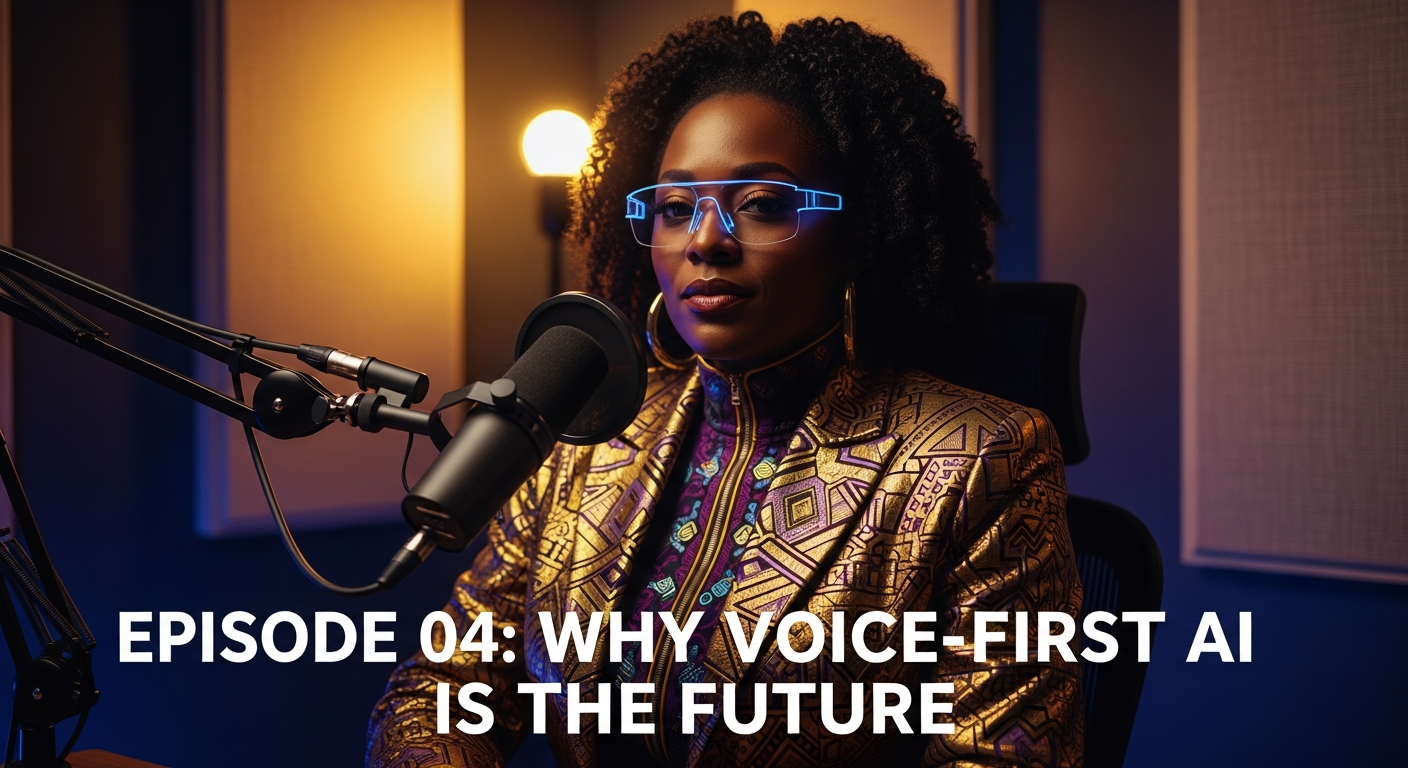
Voice AI Engineering · Episode 04
Why Voice-First AI Is the Future
Voice isn't just a feature—it's the front door: why conversation is the most natural interface and what it actually takes to engineer a voice-first AI that holds up in the real world.
Listen in my voice · AI narration (ElevenLabs clone)
Watch the episode · AI-generated video
On this page
Typing is not natural for everybody. Menus are not natural for everybody. But conversation is one of the oldest interfaces we have. If Big Mama is going to help people discover businesses, preserve culture, and get things done, voice is not just a feature. Voice is the front door.
Hey guys, I’m Chris Watkins, also known as Bingo Codes. I’m a security engineer transitioning into voice-first AI engineering while building Djembe AI and Big Mama, a culturally grounded voice-first agentic AI platform designed to help Black communities discover businesses, preserve culture, and help SMBs grow through intelligent AI systems.
Why Voice Changes the Interface
Text-based AI requires the user to stop, type, read, and respond. Voice allows the user to interact while moving, driving, cooking, working, or helping a customer. It also creates a more human sense of presence. Voice makes AI feel less like a search box and more like a conversation.
For community and SMB use cases, this matters. A business owner may not want to sit down and write perfect prompts. A community elder may prefer to speak naturally. A customer may want quick recommendations without navigating an app.
When we think about the evolution of human-computer interaction, we often think about the transition from command-line interfaces to graphical user interfaces, and then to touchscreens. Each step reduced the friction between the user’s intent and the machine’s execution. Voice is the next logical step in this progression. It removes the need for physical interaction entirely, allowing for a more seamless and intuitive experience. This is particularly important for individuals who may not be as tech-savvy or who have physical limitations that make traditional interfaces difficult to use.
Furthermore, voice interfaces can convey emotion and nuance in ways that text simply cannot. The tone, pitch, and cadence of a voice can communicate empathy, urgency, or reassurance, making the interaction feel more personal and human. This emotional connection is crucial for building trust and engagement, especially in applications designed to support communities and small businesses.
Voice Is More Than Speech-to-Text
Voice-first AI is not simply taking a chatbot and adding a microphone. A real voice experience needs speech recognition, language understanding, turn detection, interruption handling, response generation, text-to-speech, and session state.
OpenAI’s voice-agent guidance frames the architecture decision as either direct speech-to-speech live audio sessions or chained pipelines that explicitly connect speech-to-text, reasoning, and text-to-speech.1
| Architecture | What It Means | When It Helps |
|---|---|---|
| Speech-to-speech | The model works directly with live audio input and output. | Natural conversation, low latency, barge-in, and real-time interaction. |
| Chained pipeline | The app manages speech-to-text, LLM reasoning, and text-to-speech separately. | Workflows needing transcripts, deterministic logic, approvals, or tighter control. |
Building a robust voice-first system requires a deep understanding of these different components and how they interact. For example, speech recognition must be able to handle different accents, dialects, and background noises. Language understanding must be able to parse complex sentences and infer intent from context. Turn detection must be able to distinguish between a pause for thought and the end of a sentence. And text-to-speech must be able to generate natural-sounding audio that matches the persona of the assistant.
Each of these components presents its own set of engineering challenges, and integrating them into a cohesive system requires careful planning and execution. This is where the distinction between a simple voice interface and a true voice-first AI becomes apparent. A simple voice interface might just transcribe speech to text and pass it to a chatbot, but a true voice-first AI is designed from the ground up to handle the nuances and complexities of spoken conversation.
Latency Is a Product Feature
In text, a two-second delay may be acceptable. In voice, delay feels awkward fast. People expect rhythm. If the assistant takes too long, talks over the user, or misses interruptions, the illusion of conversation breaks. In voice AI, latency is not only a backend metric. Latency is part of the personality.
For Big Mama, low latency matters because the product should feel conversational and respectful. A slow voice assistant can make users repeat themselves, lose trust, or stop using the product.
Achieving low latency in a voice-first system is a significant engineering challenge. It requires optimizing every step of the pipeline, from audio capture and transmission to processing and response generation. This often involves using specialized hardware, such as edge devices or dedicated AI accelerators, as well as highly optimized software algorithms.
Furthermore, latency must be managed dynamically, taking into account factors such as network conditions and server load. This requires sophisticated monitoring and control systems that can adjust the system’s behavior in real-time to ensure a consistent and responsive user experience.
In addition to technical optimizations, managing user expectations is also crucial. For example, the system can use auditory cues, such as a subtle hum or a brief acknowledgment, to indicate that it is processing the user’s request. This can help to mitigate the perceived latency and keep the user engaged while the system generates a response.
Turn Taking, Barge-In, and Interruptions
Human conversation includes interruptions, corrections, short answers, silence, laughter, hesitation, and changes of direction. Voice-first AI has to handle those behaviors gracefully.
| Concept | Simple Meaning | Product Impact |
|---|---|---|
| Turn detection | Knowing when the user has finished speaking. | Prevents awkward cutoffs or long pauses. |
| Barge-in | Letting the user interrupt the assistant. | Makes the system feel responsive and respectful. |
| Session memory | Remembering what is happening in the current voice interaction. | Keeps the conversation coherent. |
| Tone modeling | Matching delivery to context. | Makes responses feel warmer and more appropriate. |
Handling these conversational dynamics requires a sophisticated understanding of human communication patterns. For example, the system must be able to distinguish between a user who is pausing to think and a user who has finished speaking. It must also be able to handle interruptions gracefully, stopping its own speech and listening to the user’s new input.
This requires a combination of advanced audio processing techniques, such as voice activity detection and echo cancellation, as well as sophisticated natural language understanding algorithms that can parse incomplete or interrupted sentences.
Furthermore, the system must be able to maintain context across multiple turns of conversation, remembering what was said previously and using that information to inform its current responses. This requires a robust session memory system that can store and retrieve information quickly and efficiently.
Accessibility and Cultural Fit
Voice-first AI can reduce friction for people who do not want to navigate complex interfaces. It can be especially valuable for users who prefer oral communication, multitasking, or hands-free interaction.
For Djembe AI, voice also has cultural meaning. The name Djembe evokes rhythm, gathering, and communication. Big Mama as a voice persona can carry warmth, familiarity, and guidance if designed respectfully. The goal is not to fake culture with a voice skin. The goal is to design an experience that respects how people actually communicate.
Designing a culturally grounded voice assistant requires a deep understanding of the target community’s communication styles, values, and preferences. This involves more than just selecting an appropriate voice actor; it requires careful consideration of the assistant’s vocabulary, tone, and conversational style.
For example, Big Mama might use culturally specific idioms or references to build rapport with users. It might also adopt a more conversational and empathetic tone, reflecting the values of community and mutual support that are central to Djembe AI’s mission.
Furthermore, the system must be designed to handle the diverse range of accents and dialects within the target community. This requires training the speech recognition models on a diverse dataset of audio recordings, ensuring that the system can accurately understand and respond to all users, regardless of how they speak.
Why Voice Is Harder Than Chat
Voice adds more failure points. The microphone can fail. Background noise can distort input. Speech recognition can mishear names or cultural terms. The model can misunderstand intent. Text-to-speech can sound unnatural. The network can introduce delay. The user can interrupt mid-response.
This is where my security engineering background matters. A voice agent is a distributed system with an emotional interface. That means every technical failure feels personal to the user.
When a text-based chatbot fails, it’s annoying. When a voice assistant fails, it feels like you’re being ignored or misunderstood by a person. This emotional weight makes reliability and robustness even more critical in voice-first systems.
To address these challenges, we need to apply the principles of security and reliability engineering to voice AI. This means building systems that are resilient to failure, with robust error handling and fallback mechanisms. It means implementing comprehensive monitoring and observability tools to detect and diagnose issues in real-time. And it means designing the system with security and privacy in mind from the ground up, ensuring that user data is protected and that the system cannot be exploited by malicious actors.
For example, we might implement a fallback mechanism that switches to a simpler, more robust speech recognition model if the primary model fails. Or we might use edge computing to process audio locally, reducing the reliance on a stable network connection and improving privacy by keeping sensitive data on the user’s device.
Big Mama as a Voice-First Agent
Big Mama should not feel like a form hidden behind a voice. It should feel like a conversational guide that can help users discover, plan, and act. The early version might focus on a few high-quality flows: business discovery, event recommendations, calendar planning, and SMB task support.
The product question is not, “Can I add voice to this app?” The question is, “What becomes easier, warmer, and more useful when the interface is voice first?”
By focusing on these high-quality flows, we can ensure that Big Mama delivers real value to users from day one. For example, a user might ask Big Mama to find a local Black-owned restaurant for dinner. Big Mama could not only provide recommendations but also check the user’s calendar to suggest a suitable time, and even make a reservation on their behalf.
This level of integration and automation is what separates a true voice-first agent from a simple voice assistant. It requires a deep understanding of the user’s context and intent, as well as the ability to interact with external systems and services to execute complex tasks.
As we continue to develop Big Mama, we will expand its capabilities to support a wider range of use cases, always keeping the focus on delivering a seamless, intuitive, and culturally grounded user experience.
Practical Takeaway
Voice-first AI is the future because it makes technology more natural, but it demands better engineering.
| Voice-First Advantage | Engineering Requirement |
|---|---|
| Natural conversation | Low-latency audio pipeline. |
| Hands-free use | Reliable real-time streaming. |
| Emotional presence | Thoughtful voice persona and tone design. |
| Accessibility | Robust speech recognition across users and environments. |
| Action-oriented help | Agent tools, memory, and confirmations. |
Next episode, I’m getting into the voice layer directly by looking at ElevenLabs and what it means to design Big Mama’s voice, persona, and speech generation system.
If you are building in AI, security, voice infrastructure, or community-centered technology, follow along. This series is my public proof-of-work as I learn, build, and ship Djembe AI and Big Mama in public. Drop a comment with what you want me to build or explain next, and I’ll see you in the next episode.
References
Carousel
The episode in slides
9 slides. Tap any to view full size.