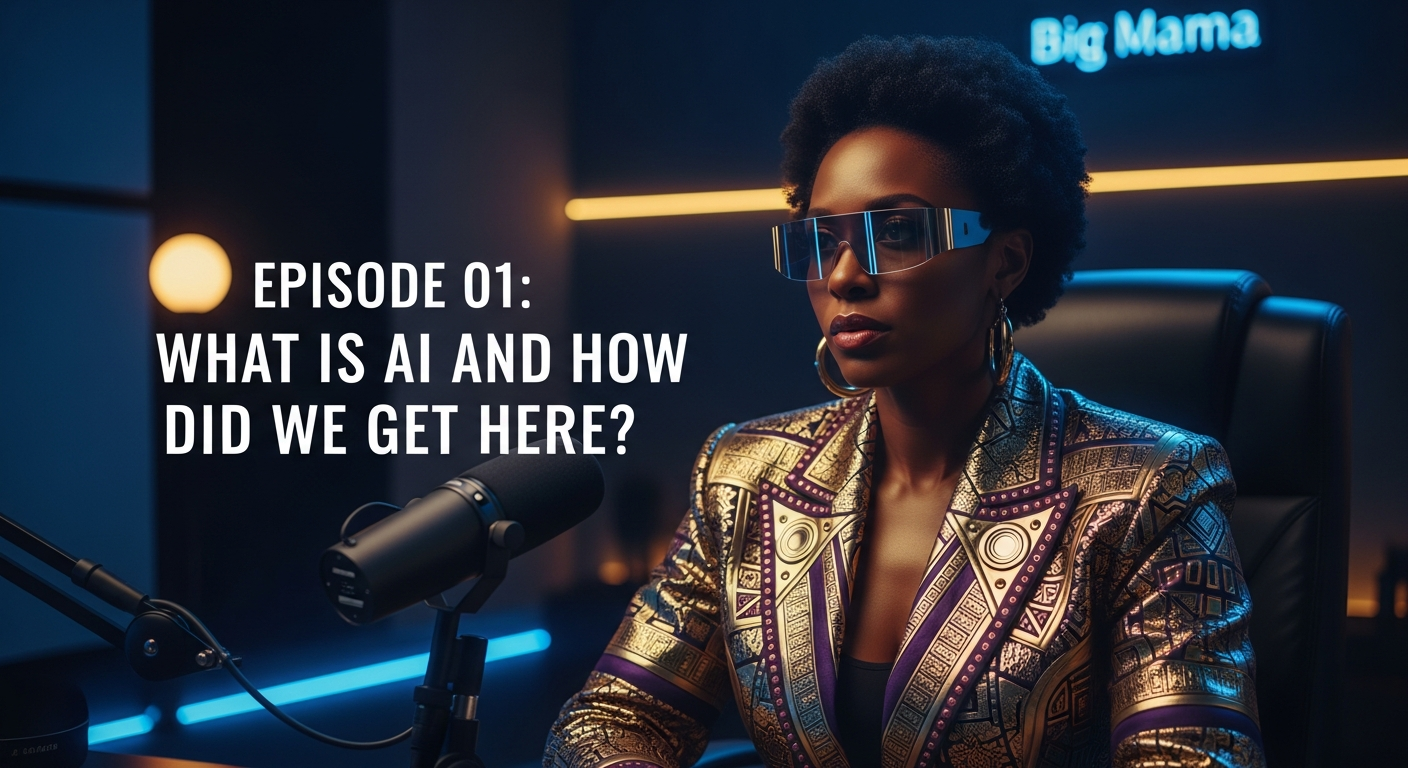
Voice AI Engineering · Episode 01
What Is AI and How Did We Get Here?
A builder's tour through AI history—from expert systems and machine learning to transformers—and why each layer matters for building Big Mama in production.
Listen in my voice · AI narration (ElevenLabs clone)
Watch the episode · AI-generated video
On this page
- Define AI Without the Hype
- Expert Systems: Rules Before Learning
- Machine Learning: Systems That Learn Patterns
- Deep Learning and Neural Networks
- Transformers: The Architecture Behind Modern Language AI
- Why This Moment Matters for Djembe AI
- Security Engineer Lens
- Big Mama Build Connection
- Practical Takeaway
- Closing
AI did not just appear when ChatGPT went viral. We got here through decades of people trying to make computers reason, classify, predict, and communicate. If I’m going to build Big Mama in public, I need to understand that history first.
In this first episode, I want to break down what AI actually is, how we got from hand-coded rules to language models, and why this matters if you are building real systems instead of just playing with demos.
Hey guys, I’m Chris Watkins, also known as Bingo Codes. I’m a security engineer transitioning into voice-first AI engineering while building Djembe AI and Big Mama, a culturally grounded voice-first agentic AI platform designed to help Black communities discover businesses, preserve culture, and help SMBs grow through intelligent AI systems.
Define AI Without the Hype
AI is the broad field of building computer systems that can perform tasks we normally associate with human intelligence. That might mean recognizing speech, understanding language, identifying patterns, making predictions, generating images, planning steps, or helping a person make a decision. The important thing is that AI is not one single technology. It is a family of methods and systems.
When I say AI, I’m talking about software that can take input, interpret patterns, and produce an output that feels like reasoning, perception, prediction, or generation.
A spam filter is AI. A fraud detection model is AI. A speech recognizer is AI. A chatbot is AI. A recommendation system is AI. A voice assistant that can hear your request, understand your goal, check your calendar, and help you make a plan is also AI.
To understand where we are, we need to understand where AI started.
Expert Systems: Rules Before Learning
The first major wave to explain is expert systems. These were systems where humans wrote down rules that represented expert knowledge. If a user says this, do that. If the data has this pattern, trigger that conclusion. Expert systems were useful because they made knowledge explicit, but they were brittle.
As a security engineer, this makes sense to me because a lot of detection logic starts as rules. If a process spawns PowerShell in a weird way, flag it. If an IP hits a threshold, alert on it. Rules are useful, but they only know what we told them to know.
The limitation is that real life creates messy inputs. People phrase things differently. Attackers change behavior. Customers ask questions in unpredictable ways. A rule-based Big Mama would fail fast because every new user request would require a new manual rule.
Rules helped, but rules could not handle the messiness of the real world.
Machine Learning: Systems That Learn Patterns
Machine learning changed the approach. Instead of manually writing every rule, engineers gave systems examples and trained them to find patterns. The model did not understand the world like a person, but it could learn relationships from data.
Traditional programming is: I write the rules, the computer follows them. Machine learning is: I give the computer examples, define what success looks like, and the system learns patterns that help it make predictions on new inputs.
If you show a model many examples of fraudulent and non-fraudulent transactions, it can learn features that predict fraud. If you show a model many labeled images, it can learn visual features. If you show it enough speech and matching transcripts, it can learn how sounds map to words.
For Big Mama, this matters because voice-first AI needs models that can handle messy human speech, accents, background noise, incomplete sentences, and context. That is not something I want to hand-code with thousands of if-statements.
Once we had more data and compute, the models started learning deeper patterns.
Deep Learning and Neural Networks
Deep learning is a subfield of machine learning that uses neural networks with many layers. These systems can learn complex patterns from large amounts of data. Neural networks are not magic brains. They are mathematical systems that transform inputs into outputs through layers of learned parameters.
A neural network is like a stack of pattern detectors. Early layers may learn simple patterns. Later layers combine those patterns into more useful representations. The deeper the model, the more complex the patterns it can represent.
More data, better hardware, and improved algorithms allowed models to perform better on speech, images, language, translation, and recommendation systems.
If Big Mama is going to understand natural speech, respond in a useful voice, and help people take action, deep learning is part of the engine. The system has to transform audio into meaning, meaning into a plan, and a plan back into natural speech.
Transformers: The Architecture Behind Modern Language AI
Transformers changed the field because they made it easier for models to process sequences like text and understand relationships across long contexts. The key concept to explain is attention. Attention helps a model weigh which parts of the input matter most when generating or interpreting language.
A transformer is powerful because it can look across a sequence and decide what parts of that sequence are relevant to what it is doing next. That is why modern language models can write, summarize, translate, answer questions, and reason across longer prompts.
Large language models are built on transformer-style architectures and trained on enormous text datasets. They can generate language because they learn statistical patterns in how words and ideas relate.
This is where the story stops being abstract and starts becoming product architecture.
Why This Moment Matters for Djembe AI
The current AI wave matters because the pieces are converging. Language models can reason through text. Speech models can convert audio to text and text back to audio. Realtime APIs and media infrastructure can support low-latency conversations. Agent frameworks can connect models to tools and memory.
Big Mama becomes possible when all of these layers start working together: speech recognition, language reasoning, voice generation, memory, tools, planning, and reliable infrastructure.
The goal is not just to build a cool assistant. The goal is to build culturally grounded AI that helps Black communities discover businesses, preserve culture, and help SMBs grow.
That distinction matters to me because AI becomes meaningful when it shows up inside real lives. A person should be able to ask Big Mama for a Black-owned restaurant with a certain vibe, a family-friendly event on Saturday, or a way to organize a small business promotion without needing to understand prompt engineering. A business owner should be able to explain what they offer once and let the system help turn that knowledge into clearer discovery, better customer answers, and more organized follow-through.
So when I study the history of AI, I am not studying it as trivia. I am studying the pieces that make a product like this possible. Expert systems taught us the value and limits of explicit rules. Machine learning taught us how to learn patterns from examples. Deep learning gave us better ways to handle speech, images, and language. Transformers pushed language AI into a new era. Now the builder question is how to combine those pieces responsibly.
Security Engineer Lens
AI systems inherit the same kinds of engineering concerns as any other production system, plus new ones. They can fail silently, hallucinate, leak sensitive data, amplify bad information, or take the wrong action if the system design is weak.
My security background makes me ask different questions. What can go wrong? What data is being stored? Who can access the tool? What happens when the model is uncertain? What does the system do when the voice pipeline breaks?
I am not only learning AI. I am learning how to build AI that can survive contact with real users.
Big Mama Build Connection
Big Mama needs an LLM reasoning layer, a voice layer, a real-time streaming layer, memory, tool integrations, safety controls, observability, and a product experience that feels natural.
So this series starts with foundations, but the destination is architecture. Every concept I learn needs to answer one question: how does this help me build Big Mama?
| Big Mama Capability | Product Meaning | Engineering Meaning |
|---|---|---|
| Voice-first interaction | Users can speak naturally instead of navigating menus or forms. | Real-time audio streaming, turn detection, barge-in handling, and low-latency response generation. |
| Agentic task execution | Big Mama can help plan, search, schedule, recommend, and coordinate. | Tool calling, function calling, workflow orchestration, state handling, and guardrails. |
| Cultural and local discovery | Users can find Black-owned businesses, cultural events, and trusted community resources. | Structured business data, retrieval, ranking, metadata quality, and feedback loops. |
| SMB growth support | Businesses can use AI assistance for discovery, planning, customer communication, and operations. | Integrations with calendars, CRMs, messaging tools, analytics, and business workflows. |
| Persistent memory | Big Mama can personalize help over time with user permission. | Vector databases, relational storage, session memory, privacy controls, and memory review. |
| Production reliability | The system can fail safely and recover gracefully. | Observability, telemetry, latency budgets, fallbacks, testing, incident review, and security controls. |
Practical Takeaway
When you think about AI, don’t just think about the magic. Think about the layers. Think about the rules, the patterns, the data, and the architecture. Think about how these systems fail and how they can be built to survive contact with real users.
Closing
Next episode, I’m going deeper into large language models. We are going to break down what an LLM is, why it feels intelligent, where it fails, and how it becomes the reasoning layer inside Big Mama.
If you are building in AI, security, voice infrastructure, or community-centered technology, follow along. This series is my public proof-of-work as I learn, build, and ship Djembe AI and Big Mama in public. Drop a comment with what you want me to build or explain next, and I’ll see you in the next episode.
Carousel
The episode in slides
9 slides. Tap any to view full size.